01
Interpret evidence locally
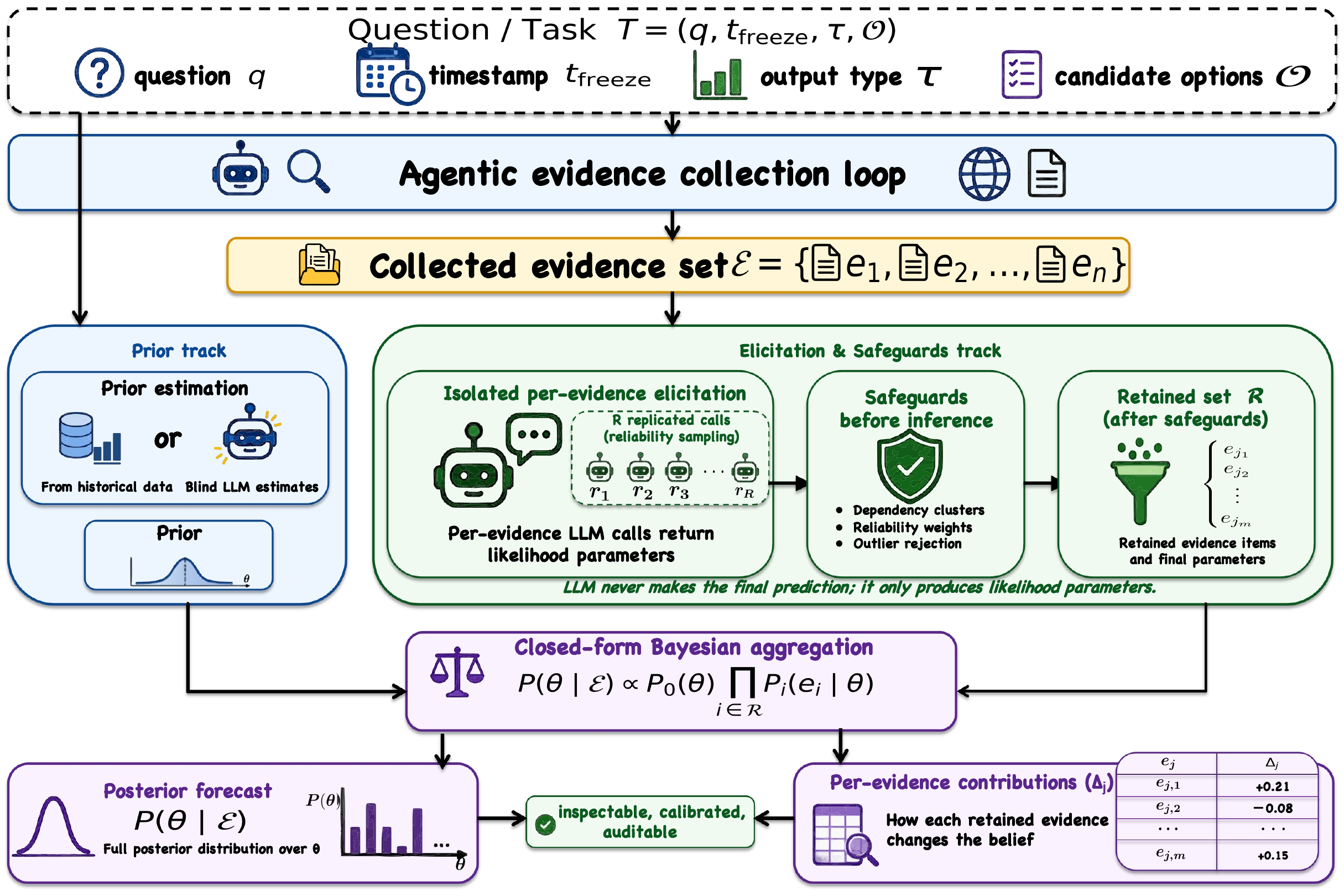
The LLM sees the task and one evidence item at a time. It returns structured likelihood parameters, not a final answer.
EMNLP 2026
LEAP interprets retrieved evidence one item at a time, elicits local likelihoods, and combines them with an explicit prior through a deterministic Bayesian update.
Shandong University · Nanjing University of Aeronautics and Astronautics · Zhejiang University · The Hong Kong University of Science and Technology (Guangzhou)
† Corresponding authors
Overview
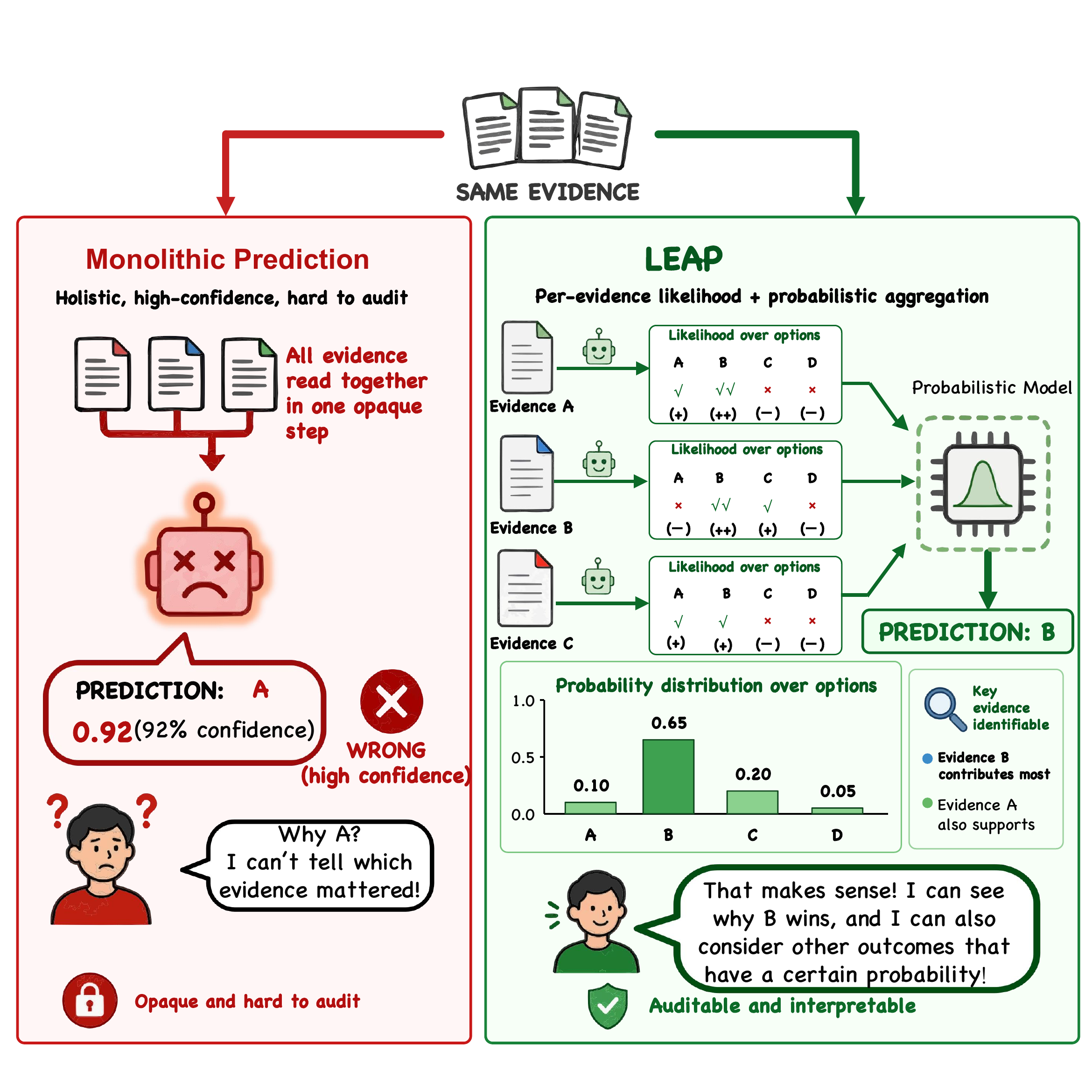
Forecasting agents have become better at search and tool use, yet the final step often remains holistic: one LLM call reads the entire evidence bundle and writes a prediction. This makes it difficult to isolate what any single source contributed and can compress uncertainty into one confident answer.
LEAP changes only this prediction stage. It keeps the gathered evidence fixed, uses the LLM as a local evidence interpreter, and lets an explicit probabilistic model make the final judgment.
Method
The LLM estimates inputs to a probabilistic model. It never receives the full evidence set during elicitation and never writes the final forecast.
01
The LLM sees the task and one evidence item at a time. It returns structured likelihood parameters, not a final answer.
02
A data-derived or elicited prior records the base rate before any retrieved evidence is examined.
03
A closed-form Bayesian update combines the prior and retained likelihoods into the final posterior distribution.
04
Leave-one-out recomputation shows how each retained evidence item changes the forecast.
Results
On the paper benchmark drawn from FutureX, GAIA, and BrowseComp, LEAP improves FutureX, Spherical score, accuracy, and NCRPS for every tested base model under the fixed ReAct-style agent loop.
The same pattern largely carries over to four external agent CLI frameworks. Their macro-average improves on all five reported metrics when LEAP replaces the final monolithic prediction step.
5
Fixed ReAct-style loop and a shared evidence set for both methods.
4
DeerFlow, Hermes, OpenClaw, and MiroFlow on unmodified traces.
3
Continuous, single-choice, and multi-choice targets.
Forecast horizon analysis
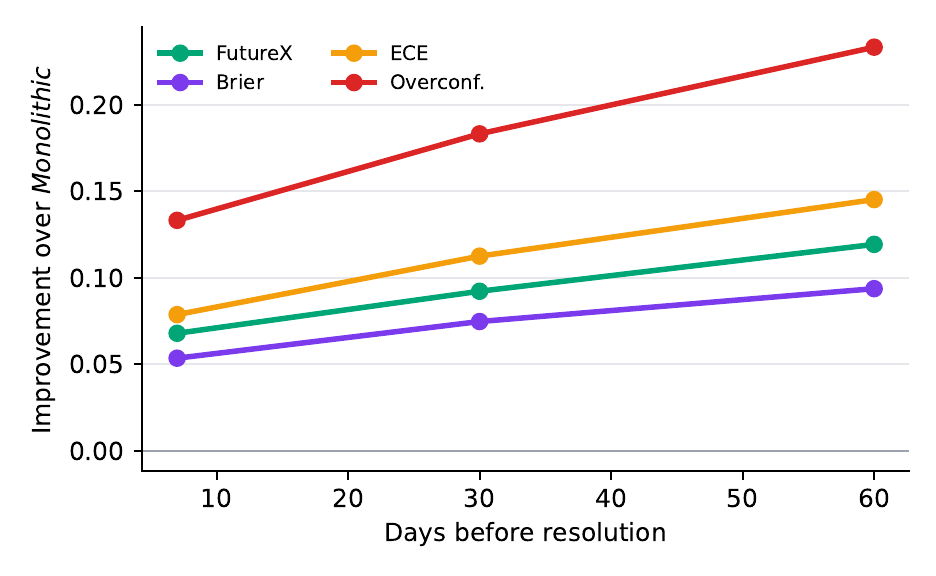
On the diagnostic subset, the absolute improvement over monolithic prediction rises across the tested 7-day, 30-day, and 60-day horizons. LEAP responds to indirect evidence with wider posteriors instead of sharp overconfidence.
Open source
The repository packages the Bayesian forecasting workflow as a skill that can operate after an agent has collected its evidence.